Blog No2 Beyond the Mustang Makeover: The truth about buying a Mustang
A wild horse deserves more than an emotional impulse purchase!
What makes mustangs so captivating can also make them incredibly easy to misunderstand- choosing a mustang through emotion, online hype, and makeover culture can lead people and horses down the wrong path.
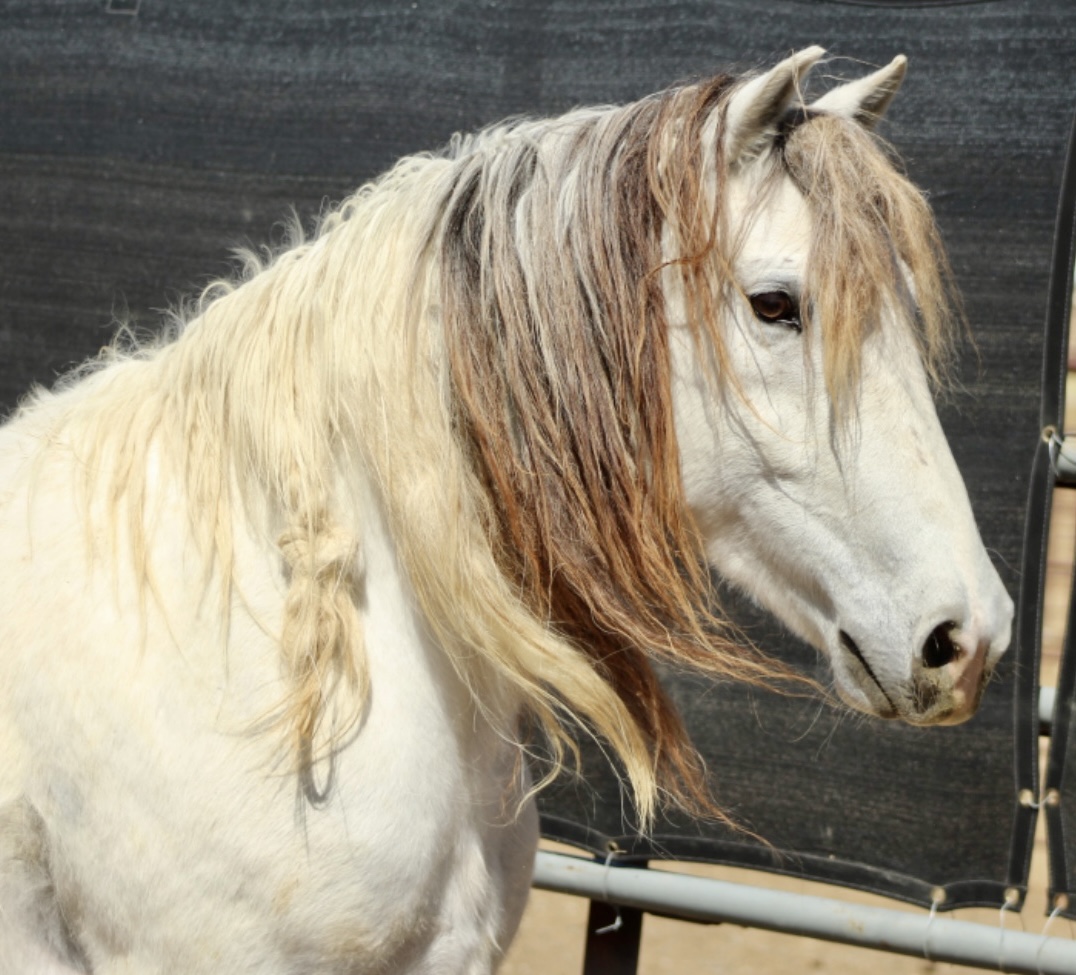
Sometimes, scrolling through the BLM adoption page almost feels dangerous to me. Even now, while writing this, I catch myself doing exactly what so many others do: I see one horse and instantly fall in love before I know anything real about him.
- The long wild mane
- The unusal markings
- The soft expression
- The eys
Before long, I am already imagining the future - bringing him home, the trailer ride, the first touch, the life we might build together.
It is incredibly easy to fall in love with the image of a mustang and the adventure people imagine comes with it. And honestly, I am no different. Even after everything I have learned, I still feel that pull.
But I also know how quickly fantasy is replaced by reality.
When I bought my first mustang, Landers who is still by my side today - reality looked nothing like the dream I had created in my head. At the time, I lived in Arizona. The holding facility was practically down the road. Mustang trainers were everywhere, speaking as if wild horses could simply be “figured out” with enough confidence and the right methods. I listened to many of them as though they were gurus.
Reality humbled me very quickly.
Because purchasing a mustang comes with responsibility far beyond what most people are told. Too often, parts of the truth are left out because the mustang world has also become a business.
This is something I have especially seen in Europe. Many mustangs imported through auctions, online sales, Facebook ads, or programs connected to Mustang Makeovers ended up with owners who genuinely had no idea what they were taking on. That does not make them bad people. Most loved the horse they bought. Most had beautiful intentions.
But beautiful intentions are not enough.
People often convince themselves that their horse will somehow be “the one” - easy, forgiving, adaptable, safer than the others. And that hope blinds them to reality. Horses are chosen emotionally: by color, mane, markings, photographs, or an emotional makeover video that captured one beautiful moment.
But the mustang itself does not know it is beautiful.
It does not know people admire its rare color or romanticize its wild mane. The horse only knows whether the human standing in front of it can provide safety, consistency, and eventually trust.
A mustang comes with a package - very much like a shelter dog, except now you are dealing with a 500-kilo prey animal whose survival instincts still live very close to the surface. People adopt rescue dogs and later realize they underestimated the responsibility. With mustangs, it is often the same story, only the consequences are much bigger.
That is why I believe the best way to purchase a mustang is the straightforward and educated way: with an experienced mustang trainer on your side from the very beginning and with a long-term plan already in place.
- Not through hype
- Not through time pressure
- Not through an emotional online bid
Programs like Ride the Brand were created exactly for this reason.
The right trainer should help you select the horse objectively, not emotionally. They should guide you through the gentling process in the United States, help evaluate the horse honestly, and continue supporting you after the horse arrives home. With today’s technology, distance and time zones are no longer real barriers. A trainer who already knows your horse can continue helping you step by step as your relationship develops.
That support matters more than people realize.
I invite trainers and mustangs to Portugal so owners can work directly with both horse and trainer together - learning horsemanship specifically designed for mustangs, not just horses in general. Because these horses require understanding, patience, and a different kind of approach.
The biggest problems I personally see with mustang ownership in Europe are not cruelty or bad intentions. It is:
- lack of experience
- lack of a good trainer and proper guidance
- lack of time
- lack of financial preparation
- unrealistic expectations
And slowly, many of these horses begin breaking down mentally and physically because their needs are misunderstood. Mustangs require far more than people imagine:
- Time
- Patience
- Space
- Consistency
- Ongoing training
- Money
- Emotional endurance
- Sometimes the acceptance that a horse may never truly want to be ridden
People rarely talk honestly about that part.
Most online stories focus on the beautiful side: the transformation photos, the emotional videos, the dramatic success stories, the image of freedom and connection. Social media often feeds ego more than reality. It makes everything look rewarding, easy, magical, and deeply meaningful every second of the journey.
In reality, working with mustangs can be frustrating. You question yourself constantly. You may work with several trainers. You spend far more money than expected. Some people eventually give up on the horse entirely.
Mustangs humble people very quickly.
I sometimes compare it to becoming a parent. Before I had children, I thought I understood parenting. Then reality arrived and humbled me. Mustangs do the same thing. Many people believe their connection will be deeper, their understanding stronger, their outcome different from everyone else’s.
But once ego enters the picture, things often begin going wrong.
This is also why I struggle with the image many people have of Mustang Makeovers. The public usually sees only the polished side of the story.
The biggest problems I personally see with mustang makeover ownership in Europe are not cruelty or bad intentions. It is:
- The beautiful photos
- The emotional music
- The drama before-and-after moments
- The performances and auctions
What people rarely see is the pressure behind it all:
- The deadlines
- The exhaustion
- The shortcuts
- The stress
- The emotional suppression that can happen when horses are pushed to perform within an extremely short period of time
And once that horse belongs to you, you become the one living with whatever was rushed, skipped, or emotionally buried along the way.
That is why I personally would never recommend purchasing a mustang directly from a makeover event — especially not without experienced guidance.
Do it right from the beginning.
Give the horse real time.
Because the real relationship with a mustang is not built through riding first. It begins with trust. Groundwork. Quiet consistency. Learning how to make the horse feel safe beside you.
Personally, I do not believe young horses - especially those five years old or younger - should be ridden at all. Before performance comes balance, confidence, emotional stability, and partnership.
Too many people rush toward performance instead of relationship.
A mustang does not care about social media photos or the dream of owning something “wild.” What matters to the horse is whether it feels safe with you.
The discipline itself matters far less than the relationship behind it. Whether you eventually enjoy trail riding, ranch work, liberty work, dressage, working equitation, or simply quiet rides through open country is secondary to the trust you build first.
And then there are the basics people constantly underestimate:
- Space
- Movement
- Herd
- Hay
- Proper living conditions
For mustangs, these are not luxuries. They are necessities.
If you cannot consistently provide those things, then honestly, you should not get a mustang.
And despite everything I have written here, I am not saying people should avoid mustangs.
Not at all.
In many ways, I believe they are extraordinary horses - unlike anything most people will ever experience. Sharing your life with one can become one of the most rewarding journeys imaginable.
- When done correctly
- Not because of makeover hype
- Not because of social media
- And not because of one beautiful photograph online
There is so much beauty in doing this the right way - slowly, honestly, transparently, and with the horse’s long-term wellbeing at the center of every decision.
Because in the end, these horses are not looking for admiration.
They are looking for safety, understanding, and a life that allows them to truly be horses.
If you are considering buying a mustang, please reach out to me. I would genuinely love to help guide you onto the right path - with the right trainer, the right preparation, and the right horse for your life.
Hoofs and Heart Beats,
Karin & Landers
And here publicly shared afterthought to leave you with from a former Mustang Makeover Trainer:
“People fall in love with the final picture, but very few ever see what it took to get there.”
I spent years around the Mustang Makeover world. I watched wild horses arrive untouched and uncertain, and I watched them walk into arenas beneath lights and applause only a few months later. To the public, it looked inspiring - almost magical. Transformation sells hope. A horse once considered ‘wild’ suddenly carrying a rider, standing quietly in front of a crowd, becoming someone’s dream horse.
But there is another side to that story.
What people rarely see is the pressure behind the scenes. The countdown that starts the moment the horse arrives. The expectation to show results quickly. The reality that these horses are not only being gentled - they are being prepared for a performance, for presentation, and eventually for sale.
A mustang does not arrive as a blank page. These horses carry survival, instinct, sensitivity, and history inside them. Real trust cannot be rushed. Yet the entire format depends on speed, visible progress, and the ability to create a transformation within a fixed amount of time.
I saw talented trainers trying to do right by the horse within that system. I also saw horses adapting quickly, not always because they were mentally ready, but because repetition, pressure, and controlled routines can create the appearance of readiness.
And then the event ends.
The lights disappear. The cameras are gone. The horse leaves the structured environment and enters a completely different reality with a new owner who often falls in love with what they saw in the arena, without understanding what it actually took to create that moment.
That is where the real story begins.
Because horsemanship is not built in a spotlight. It is built slowly - in patience, repetition, setbacks, quiet moments, groundwork, trust, and time.
These horses are not entertainment pieces. They are living animals, and they carry every rushed step, every shortcut, and every human expectation long after the applause is over.
At some point, I began asking myself whether speed and spectacle truly serve the horse - or whether they mainly serve our need to witness transformation.
I still love mustangs deeply. Maybe more than ever.
But loving them also means being honest about what they need.”
I would love to hear from you, please comment below.
Hi Karin
Thank you for sharing this.
I'm not a horse professional - let alone an expert on Mustangs. In fact, I've never even met one. The idea of having a Mustang as a companion has always been more of a dream, perhaps even a romantic longing for freedom.
Reading your posts, I realized that what you're describing is probably not unique to Mustangs. It seems to happen in many parts of the horse world - I especially think of the culture and business surrounding the PRE.
I was fortunate to grow up with a PRE who, in his own way, went through a story that reminds me of what you describe. He wasn't an easy horse, but he taught me a great deal. Because of life circumstances, I stopped riding for several years. Since two years, I'm slowly finding my way back to horses - and with that, my dream of one day sharing my life with a Mustang returned 😅. But yes, this image is nurtured by a specific narrative, it began with a film about these very Mustangs you write about, exported to Europe; it continued with social media etc.
The more I learn about Mustangs, horsemanship in general and the industry around horses, the more I feel that it is less about Mustangs, PREs, or any particular breed, and much more about an attitude. About how we choose to relate to horses, to nature, and ultimately to one another. And of course, as you write, it is also about resources.
I also wonder whether the community we surround ourselves with makes the biggest difference. As someone returning to the horse world after a long break, I find it just as challenging to find the right people and places as it is to find the right horse. Even organizations like the Mustang Makeover, whose values initially resonate with me, become more complex once you start looking beneath the surface.
So I keep wondering: how do we orient ourselves in this vast and sometimes confusing landscape? Is it really about the Mustang, or is it about a philosophy of living and relating?
Maybe that's the question I'm really trying to answer for myself.
Thank you so much for your thoughtful reply. I really appreciate it because I find myself asking many of the same questions.
Yes, I think the PRE hype and the Mustang hype are probably more similar than many people would like to admit. Of course, I don't mean that PREs and Mustangs are the same, Mustangs are not a breed, but the stories and narratives we create around them often follow similar patterns.
May I ask which country you're in? If you're ever in Portugal, or if our paths cross somewhere else, I'd love for you to meet my Mustangs and me in person. I think meeting one as an individual horse is a very different experience from the images and expectations we often carry in our minds.
I also completely agree that the community we choose is incredibly important. Over the years, I've consciously distanced myself from people with right-wing political ideologies, as well as from horse people who thrive on that as well as hype and exclusivity. It simply doesn't reflect the values I want to live by or bring into my work with horses.
Like you, I don't think the real question is whether it's about Mustangs, PREs, or any other type of horse. The deeper question is: How do we want to relate? Every one of us has to develop our own philosophy of living and relating - to horses, to people, and to the natural world. I'm still learning too.
That's exactly what I hope my workshops can become: a place where like-minded people come together, share thoughtful horsemanship, ask difficult questions, and, of course, spend meaningful time with the horses.
Hi Karin,
Thank you for your thoughtful reply.
I'm based in Switzerland - where the Mustang hype doesn't seem to have taken hold that much (at least not yet).
I'd love to meet Mustangs and like-minded people. Hopefully our paths will cross one day so we can continue this conversation in person.
One aspect I'm still trying to figure out is how to genuinely put the relationship and wellbeing first while navigating the economic realities that come with horses. For me, financial limitations are probably the biggest obstacle to becoming more involved in the horse world or one day having a companion of my own.
Your reply left me with one more question. If, in the end, it's really about a philosophy of living and relating, and it could be any horse, why Mustangs?
I have the feeling that not everything can be explained by hype or a narrative. There seems to be something about these horses that continues to draw people in. Do you think it lies in their history or perhaps in the challenges they bring and in the kind of human they invite us to become? I'd be very interested to hear your thoughts.
All the best!
Hi,
Thank you for your thoughtful email. I really enjoyed reading your reflections.
To answer your question, it could really be any horse.
My draw to the Mustang is entirely my horse's fault! He is a Mustang, so I admit I am biased when it comes to them.
What fascinates me is that, if a Mustang has actually lived in the wild for several years, ideally at least the first three to five years of its life, it comes with something very unique. These horses are deeply herd socialized. Their senses are highly developed, and they have experienced life in a way that domesticated horses simply haven't. That doesn't make them "better" horses, just different.
I also work with people with PTSD and with soldiers. In that work, I have found that Mustangs often bring another layer of depth to the coaching process. Their authenticity, sensitivity, and awareness can create remarkable moments of connection. That is one of the reasons I feel so drawn to wild horses.
For me, it is not about the hype at all. It is about appreciating these horses for who they are and respecting the life they have lived before coming into ours. That is why I am looking for like minded people, people who want to meet horses as individuals rather than as a trend or an idea.
At the same time, I truly believe this philosophy is not exclusive to Mustangs. A meaningful relationship can be built with any horse. The principles remain the same, listening, respecting, observing, and allowing the horse to be who they are. The Mustang simply happens to speak to my heart because of my own journey.
I also appreciate what you shared about the financial realities of horses. It's a very real challenge, and I think many of us wrestle with balancing our ideals with practical limitations. I hope that, in time, you'll find your own way into this world, whatever that looks like.
I would love for our paths to cross! Come visit me and the horses at Rancho Terra Bravo. I think we would have some wonderful conversations in person.
Warmly,
Karin